Introduction: Why Collar Choice Matters for Your Husky
Siberian Huskies are intelligent, independent, and notoriously strong pullers. Their thick double coat and history as sled dogs make them natural escape artists. Choosing the right collar for training is crucial not only for effective communication but also for your dog's safety and comfort. A poorly chosen collar can lead to injury, escape, or reinforce bad habits. This guide covers the best collar types for husky training, their pros and cons, and how to use them correctly.
Understanding the Husky's Unique Needs
Before selecting a collar, it's important to understand the Husky's physical and behavioral traits:
- Pulling instinct: Huskies are bred to pull sleds, so they naturally lean into pressure. A standard flat buckle collar may encourage choking and is ineffective for training.
- Escape artistry: Their neck is often as thick as their head, allowing them to slip out of poorly fitted collars. They are experts at backing out of harnesses.
- Sensitive neck: Huskies have a layer of thick fur, but their trachea can be easily damaged by excessive force. Avoid collars that put constant pressure on the throat.
- High prey drive: Training tools must provide enough control to manage sudden lunges after squirrels or other animals.
Types of Collars for Husky Training
Flat Buckle Collar
The simplest collar, made of nylon or leather with a buckle. It's fine for daily wear with ID tags, but not recommended for training or walking. Huskies can easily back out, and it offers no correction for pulling. Use only for identification.
Best for: Everyday wear, attaching tags. Not for training.
Martingale Collar
Also called a limited-slip collar, it has a loop that tightens slightly when the dog pulls, preventing escape without choking. The tightness is limited, so it's safer than a choke chain. Martingales are a popular choice for huskies because they provide gentle correction and prevent slipping out.
Pros: Humane, effective for escape artists, good for training loose-leash walking.
Cons: Not a full correction tool; some huskies still pull strong enough to ignore the tightening.
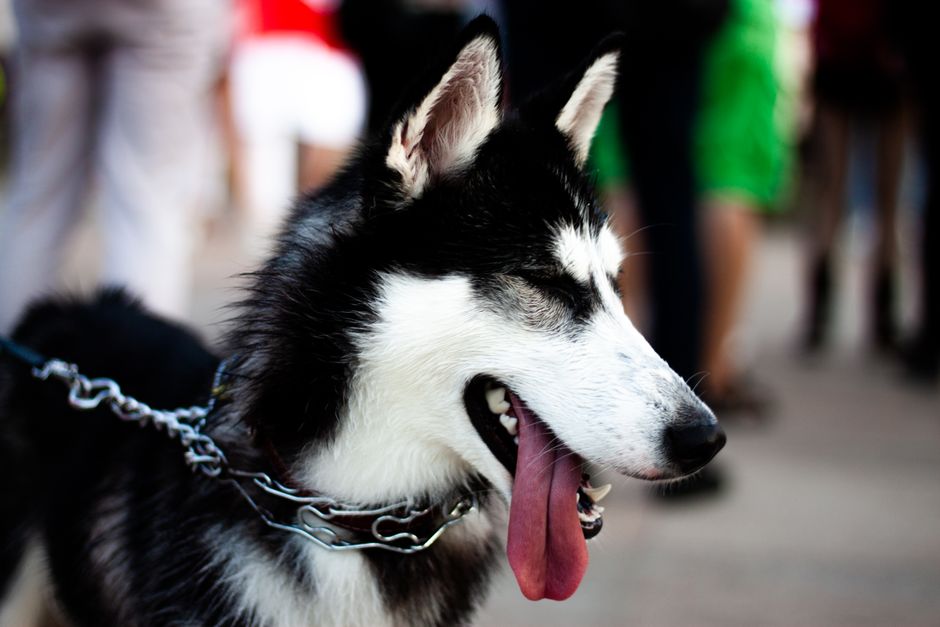
Prong Collar (Pinch Collar)
A controversial tool consisting of metal prongs that pinch the skin when the dog pulls, mimicking a mother dog's correction. Many trainers recommend prong collars for strong, headstrong dogs like huskies, but they require proper fitting and usage. Used incorrectly, they can cause injury. Always use with a training leash and under professional guidance.
Pros: Very effective for strong pullers, immediate feedback.
Cons: Can cause skin damage if misused, negative public perception, need for education.
E-Collar (Remote Training Collar)
An electronic collar that delivers a mild static stimulation (not shock) via a remote. Modern e-collars are used for communication, not punishment. They are excellent for off-leash training, recall, and reinforcing commands at a distance. Huskies respond well to consistent signals, but the collar must be introduced gradually.
Pros: Unmatched off-leash control, works for soundproof recall, adjustable stimulation levels.
Cons: Requires training to use correctly, initial cost, some owners misuse it.
Head Halter (e.g., Halti, Gentle Leader)
A harness-like strap that goes around the dog's muzzle and behind the ears. It works by turning the dog's head when they pull, giving the handler better control. Huskies may resist initially, but many owners swear by head halters for managing strong pullers.
Pros: Excellent control, reduces pulling, no pressure on throat.
Cons: Can be uncomfortable, dogs may try to rub it off, not suitable for dogs with short snouts.
Harness (Front-Clip vs. Back-Clip)
A harness distributes pressure across the chest and back, safer for the neck. However, a back-clip harness may actually encourage pulling for a husky (since they're bred to pull). A front-clip harness attaches at the chest, turning the dog to the side when they pull, which helps reduce momentum. Many trainers recommend a harness with both clips for versatility.
Pros: No neck pressure, good for recreational walks, front-clip aids training.
Cons: Back-clip can encourage pulling, some huskies can still escape harnesses.
What to Avoid for Husky Training
- Choke Chains: Can cause tracheal collapse and don't limit tightening, dangerous for huskies.
- Retractable Leashes: They give constant tension, teach your dog to pull, and can snap or cause injuries.
- Ill-fitting collars: Either too tight (choking) or too loose (escape). Always check fit.
Practical Tips for Collar Training
- Introduce gradually: Let your husky sniff and wear the collar for short periods before attaching the leash.
- Check fit: You should be able to fit two fingers between the collar and the neck. For martingales, the tightening loop should not fully close.
- Use positive reinforcement: Pair the collar with treats and praise to create a positive association.
- Combine with training: No collar alone teaches loose-leash walking. Use consistent cues and rewards.
- Safety first: Never leave a training collar (prong, e-collar) on unattended. Remove when not training.
Top Recommendations for Husky Training Collars
| Collar Type | Best For | Example Brand |
|---|---|---|
| Martingale | Everyday training, escape prevention | Lupine, PetSafe |
| Prong | Strong pullers, adult dogs | Herm Sprenger |
| E-Collar | Off-leash recall, advanced training | Dogtra, SportDOG |
| Head Halter | Walking control, immediate pulling reduction | Gentle Leader, Halti |
| Front-Clip Harness | Recreational walks, safety | Ruffwear, Kurgo |
Conclusion: Find What Works for You and Your Husky
There is no single "best" collar for all huskies. Consider your dog's temperament, your training goals, and your experience level. Start with a martingale or front-clip harness, and escalate to a prong or e-collar if needed, preferably with a professional trainer. Always prioritize humane, force-free methods. With the right tool and consistent training, your husky can become a well-behaved companion.